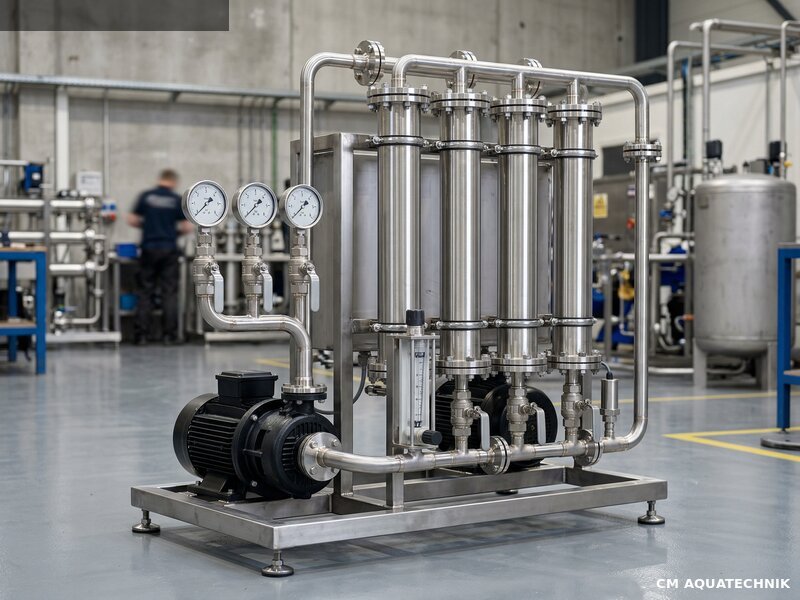
Micro Filters
Micro filters and microfiltration modules in PP, PVDF or PES with 0.05–0.45 µm pores, as hollow-fibre or pleated cartridges for particle removal.
Technical Specifications
| Pore Size | 0.05 – 0.45 µm |
|---|---|
| Membrane Material | Polypropylene (PP) · PVDF · PES |
| Module Type | Hollow-fibre · pleated cartridge · flat sheet |
| Flux Rate (nominal) | 200 – 800 LMH |
| Particle Removal | > 99.99% particles > 0.1 µm |
| Operating Pressure | 0.3 – 3.0 bar TMP |
| Max Temperature | 40 °C (PP) · 80 °C (PVDF) |
| Sterilisation | Autoclavable (cartridge) · CIP/SIP (hollow-fibre) |
| Standards | FDA 21 CFR · NSF 61 · CE |
Key Features
- Absolute 0.1 µm pore size removes all bacteria and Cryptosporidium
- PVDF membranes withstand aggressive chemical CIP at high pH
- Pleated cartridge versions are drop-in for existing housings
- SIP (steam-in-place) capability for pharmaceutical aseptic applications
- Low extractables: compliant with FDA 21 CFR Part 177
- Available in sterile-ready configurations with integrity test ports
Applications
- Pharmaceutical water (WFI pre-treatment)
- Sterile filtration in food production
- Beverage clarification and cold stabilisation
- Pre-treatment for nanofiltration
- Biotech fermentation broth clarification
- Wine, beer, and juice filtration
Product Overview
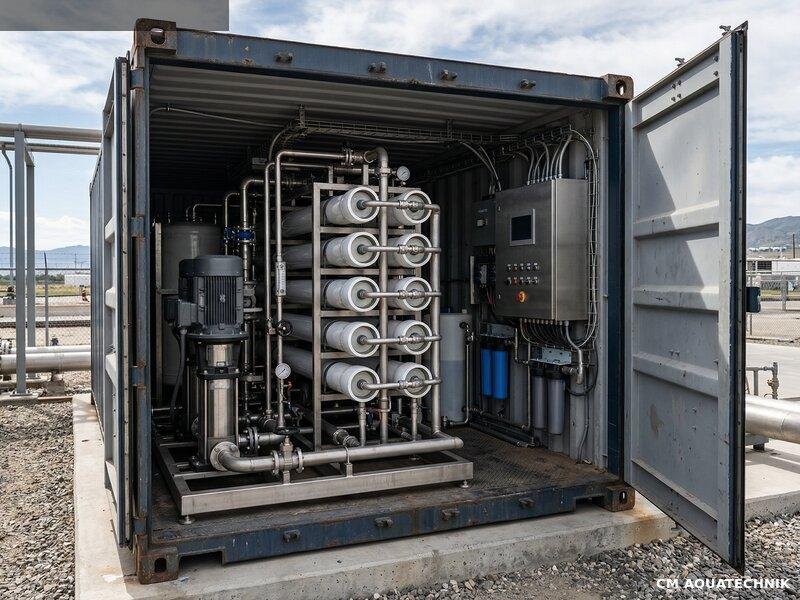
CM Aquatechnik supplies microfiltration (MF) membrane modules and systems for particle removal down to 0.1 µm. Available in polypropylene (PP) and PVDF membrane materials in both hollow-fibre and pleated cartridge configurations. Suitable for pre-treatment prior to ultrafiltration or nanofiltration, and for final filtration in food, beverage, and pharmaceutical applications.
How microfiltration works
A microfiltration membrane is a sieve with pores of 0.05 to 0.45 µm. It holds back suspended solids, bacteria and protozoa and lets dissolved salts and most dissolved organics pass.
- Pleated cartridges — the membrane is pleated around a core and works in dead-end mode: all the water passes through the membrane and the cartridge is replaced when it is loaded. Used for final and sterile filtration.
- Hollow-fibre modules — thousands of fibres in a housing, backwashed every 20–60 minutes with filtrate and cleaned chemically at longer intervals. Used for continuous treatment of larger flows.
- Integrity test — a pressure-hold or bubble-point test shows whether the membrane and its seals are intact.
Selection and sizing
- Pore size — 0.2 µm is the standard for bacteria retention, 0.1 µm where mycoplasma must be held back, 0.45 µm for clarification and as a pre-stage.
- Flux and area — the design flux depends on the solids content of the feed. Clean water allows several hundred L/m²·h, surface water and process liquids far less. A pilot test or operating data from a comparable application gives the reliable value.
- Pre-filtration — a depth filter of 1–5 µm ahead of the membrane multiplies the life of a membrane cartridge.
- Material — PES for high flow and low protein binding, PVDF for chemical resistance and hot cleaning, PP for general industrial duty.
- Cleaning and sterilisation — hot water, steam or chemical sanitisation determine the choice of cartridge construction, seals and housing.
Where viruses and colloids must also be removed, ultrafiltration is the next finer step.
What determines the cost
- Membrane area — set by the flow and the design flux.
- Membrane material and validation — sterilising-grade cartridges with certificates cost more than industrial grades.
- Housing — hygienic stainless steel housings with polished surfaces for food and pharmaceutical duty.
- Automation — backwash and cleaning sequences of hollow-fibre systems need valves, pumps and a control system.
- Operating cost — cartridge replacement, or cleaning chemicals and membrane replacement for hollow-fibre modules.
Frequently asked questions
What is the difference between microfiltration and ultrafiltration?
Microfiltration membranes have pore sizes of around 0.05–0.45 µm and remove suspended particles, bacteria and protozoa such as Cryptosporidium. Ultrafiltration uses finer pores and additionally retains colloids and macromolecules, which is why microfiltration is often used as pre-treatment ahead of ultrafiltration or nanofiltration.
Which membrane material should I choose: PP, PVDF or PES?
Polypropylene (PP) membranes are suitable up to 40 °C, while PVDF membranes withstand temperatures up to 80 °C and aggressive chemical cleaning (CIP) at high pH. PES is available as a further option, and we select the material according to the liquid, its temperature and your cleaning and sterilisation regime.
How are micro filters cleaned and sterilised?
Pleated cartridge versions are autoclavable and fit as drop-in replacements in existing housings, while hollow-fibre modules are cleaned and sterilised in place by CIP/SIP. For pharmaceutical and aseptic applications, sterile-ready configurations with integrity test ports are available.
What information do you need for a quotation?
Please tell us the flow rate, the liquid to be filtered and its temperature, the particle load or turbidity, the required retention rating, the available operating pressure, your cleaning and sterilisation requirements, the applicable standards and whether existing housings are to be used. Send us your requirements and we will prepare a proposal within 48 hours.
Last updated: · Technical data are typical values; the final design follows your water analysis and project data. Stock availability in Neuss and lead times are confirmed with the quotation.