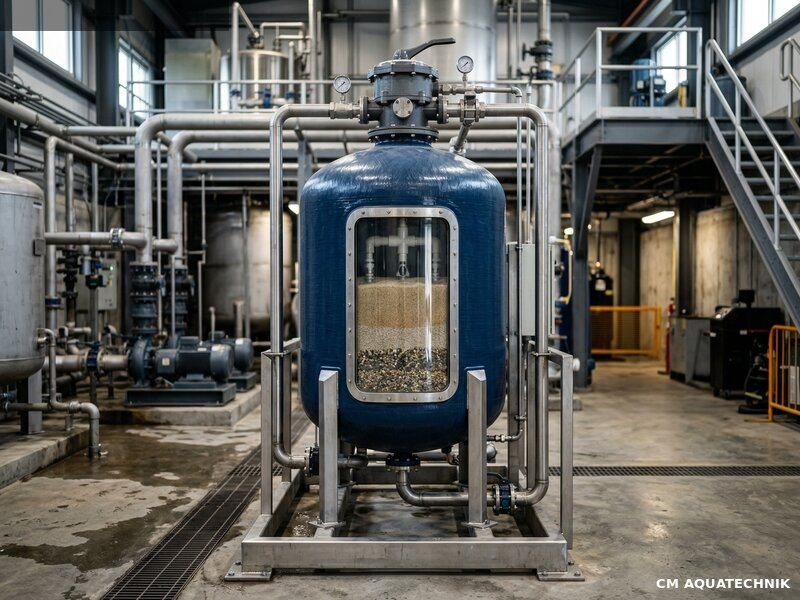
Multimedia Filters
CM Aquatechnik supplies pressure multimedia filters for turbidity and suspended solids removal from raw water prior to RO, softening, or other downstream treatment processes. Each filter contains grad
Technical Specifications
| Flow Capacity | 0.2 – 200 m³/h per vessel |
| Outlet Turbidity | < 1 NTU (from < 50 NTU inlet) |
| Filtration Rate | 8 – 20 m/h |
| Media Layers | Quartz sand · anthracite · gravel |
| Backwash Method | Hydraulic upflow + air scour (optional) |
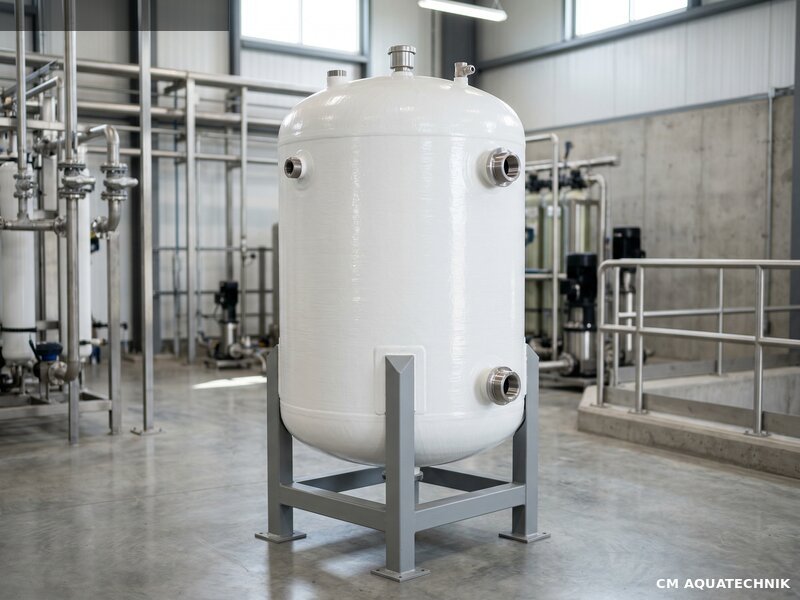
| Vessel Material | FRP or epoxy-lined carbon steel |
| Vessel Diameters | 6" – 84" (150 mm – 2,134 mm) |
| Control Valve | Multiport manual or automatic |
| Service Cycle | 8 – 72 hours between backwash |
| Operating Pressure | 2.5 – 6.0 bar |
| Standards | NSF 61 · DIN 2401 · CE |
Key Features
- Multi-layer media provides deep filtration down to 10 µm
- Automatic backwash sequence removes accumulated solids
- NSF61 vessels available for potable water applications
- Low backwash water consumption (2–5% of throughput)
- Air scour option for improved media cleaning
- Differential pressure monitoring for backwash initiation
Applications
- Raw water pre-treatment for RO
- Drinking water filtration
- Cooling tower make-up water
- Process water clarification
- Swimming pool water treatment
- Industrial intake water filtration
Product Overview
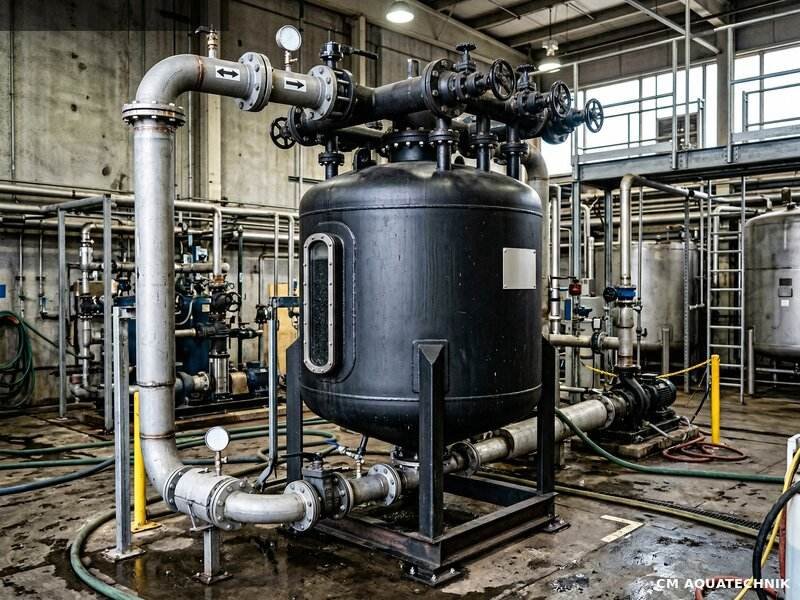
CM Aquatechnik supplies pressure multimedia filters for turbidity and suspended solids removal from raw water prior to RO, softening, or other downstream treatment processes. Each filter contains graded layers of quartz sand, anthracite, and supporting gravel, providing depth filtration that removes particles from 10 to 50 µm.
Available in FRP or carbon steel vessels with manual or fully automatic backwash control valves, these filters achieve treated water turbidity below 1 NTU consistently. High-rate designs operate at surface loading rates up to 20 m/h.
Frequently asked questions
How is a multimedia filter sized?
The vessel cross-section is determined by dividing the required flow rate by the design filtration rate, which typically lies between 8 and 20 m/h depending on raw water quality. Our vessels range from 150 mm to 2,134 mm in diameter for flows of 0.2 to 200 m³/h per vessel, and several vessels can be operated in parallel for larger flows. The raw water turbidity and the downstream process also influence the selected filtration rate.
Which filter media are used in a multimedia filter?
The filter bed consists of graded layers of anthracite, quartz sand and supporting gravel. The coarser, lighter anthracite at the top retains larger particles, the finer quartz sand below removes smaller particles down to around 10 µm, and the gravel layer supports the bed. This arrangement provides true depth filtration and longer service cycles than a single-media filter.
How often does a multimedia filter need to be backwashed?
Service cycles are typically 8 to 72 hours between backwashes, depending on the solids load; backwash can be initiated by time or by differential pressure monitoring. Backwashing is carried out by hydraulic upflow, optionally combined with air scour, and consumes only 2 to 5% of the throughput. With automatic control valves the backwash sequence runs without operator intervention.
What information do you need for a quotation?
Please tell us the required flow rate, the raw water turbidity and suspended solids content, any other relevant parameters such as iron or manganese, the operating pressure, the downstream process (for example RO or softening), whether manual or automatic valves are preferred and whether the filter is for potable water use. Send us your requirements and we will prepare a proposal within 48 hours.