Blowers
Blowers for wastewater aeration: rotary lobe and turbo blowers for 50–10,000 Nm³/h, with turbo units saving up to 40% energy over fixed-speed types.
Technical Specifications
| Types | Rotary lobe (Roots) · single-stage turbo |
|---|---|
| Flow Range | 50 – 10,000 Nm³/h |
| Pressure Range | 300 – 1,000 mbar (0.3 – 1.0 bar) |
| Motor Power | 2.2 – 250 kW (rotary lobe) · 4 – 500 kW (turbo) |
| Motor Efficiency | IE3 (rotary lobe) · IE4 (turbo with PM motor) |
| Speed Control | Belt drive · direct drive with VFD |
| Noise Level | Silenced to < 75 dBA at 1 m |
| Lubrication | Oil-flooded (rotary lobe) · oil-free (turbo) |
| Cooling | Air-cooled (standard) · water-cooled (large models) |
| Standards | CE · ISO 1217 · IEC 60034 |
Key Features
- Turbo blower achieves 35–45% energy saving over fixed-speed Roots blower
- Variable frequency drive (VFD) on rotary lobe enables flow modulation
- Oil-free turbo blower eliminates risk of oil contamination in process air
- Stainless steel air passages for food and pharmaceutical service
- Acoustic enclosures reduce noise to < 75 dBA for indoor installation
- Full instrumentation package: pressure, temperature, vibration monitoring
Applications
- Activated sludge aeration
- MBBR and MBR aeration
- Aerobic sludge digestion
- Ozone generation air supply
- Pneumatic conveying of screenings
- Air knife and flotation air supply
Product Overview
CM Aquatechnik supplies rotary lobe (Roots-type) blowers and high-efficiency turbo blowers for aeration and process air supply in wastewater treatment plants. Rotary lobe blowers are robust and low-maintenance for flow-controlled aeration; turbo blowers with variable-speed direct-drive motors achieve up to 40% energy saving compared to fixed-speed rotary lobe blowers.
How the blower types work
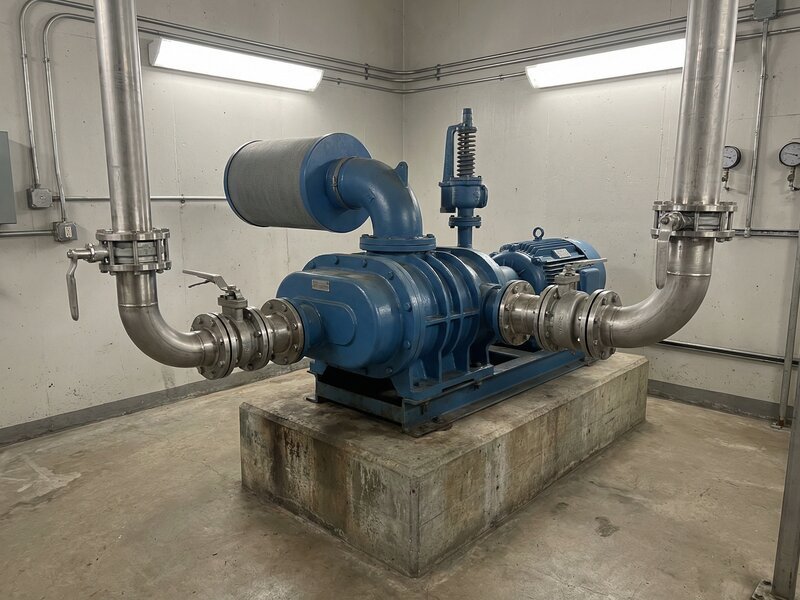
- Rotary lobe blower — two rotors turn in opposite directions and push a fixed volume of air per revolution against the pressure of the system. The flow is proportional to the speed and hardly depends on the pressure, so a frequency converter gives a wide control range of about 30–100 %. Robust and tolerant of changing conditions.
- Turbo blower — an impeller running at very high speed accelerates the air and converts the velocity into pressure. A permanent-magnet motor drives the impeller directly on air or magnetic bearings, without oil and without gears. Highest efficiency at larger air flows, with a control range of about 45–100 %.
Every blower package includes an inlet filter and silencer, a discharge silencer, a non-return valve, a pressure relief valve and flexible connections. The compressed air leaves the blower hot, so the first section of the discharge pipe is made of steel.
Selection and sizing
- Air flow — the maximum and the minimum demand from the aeration design. The ratio between them decides the number and the type of blowers.
- Pressure — the water depth above the diffusers (about 98 mbar per metre) plus the losses in the diffusers and the pipework. A tank with 5 m of water needs about 550–600 mbar.
- Site conditions — the highest inlet temperature and the altitude, because warm and thin air contains less oxygen per cubic metre.
- Number of units — usually two or three duty blowers and one standby, with the smallest unit able to cover the minimum demand.
- Control — the dissolved oxygen in the tanks sets the air demand; the blowers follow the header pressure or a direct flow setpoint.
- Blower room — ventilation removes the heat given off by the machines; acoustic hoods keep the noise level down.
The air is distributed in the tanks by fine-bubble diffusers.
What determines the cost
- Air flow and pressure — they set the machine size and the motor power.
- Blower type — turbo blowers cost more to buy and use less energy; rotary lobe blowers are cheaper and more flexible at small flows.
- Equipment — frequency converter, acoustic hood, instrumentation and a master controller for several machines.
- Operating cost — over the life of a blower, energy costs many times the purchase price. Maintenance covers filters, and oil and belts on rotary lobe blowers.
Frequently asked questions
Rotary lobe or turbo blower: which is right for my plant?
Rotary lobe (Roots-type) blowers are robust and low-maintenance, and a variable frequency drive allows flow modulation. Turbo blowers with variable-speed direct-drive motors are oil-free and achieve up to 40% energy saving compared with fixed-speed rotary lobe blowers, which makes them attractive where aeration runs continuously and energy costs are significant.
How is a blower sized?
A blower is sized on the required air flow (Nm³/h) and the discharge pressure, which is determined mainly by the water depth above the diffusers plus losses in the pipework and diffusers. Our range covers 50 to 10,000 Nm³/h at 300 to 1,000 mbar, so the right machine can be selected for both small and large plants.
Can blowers be installed indoors?
Yes. Acoustic enclosures reduce the noise level to below 75 dBA at 1 m, which makes indoor installation possible. Smaller units are air-cooled as standard, larger models are available water-cooled, and a full instrumentation package for pressure, temperature and vibration monitoring is available.
What information do you need for a quotation?
Please tell us the required air flow (minimum, normal and maximum), the discharge pressure or diffuser submergence, the application and the installation site (indoors or outdoors, altitude and ambient temperature). Your preferred blower type and any requirements for oil-free air or speed control are also helpful. Send us your requirements and we will prepare a proposal within 48 hours.
Last updated: · Technical data are typical values; the final design follows your water analysis and project data. Stock availability in Neuss and lead times are confirmed with the quotation.