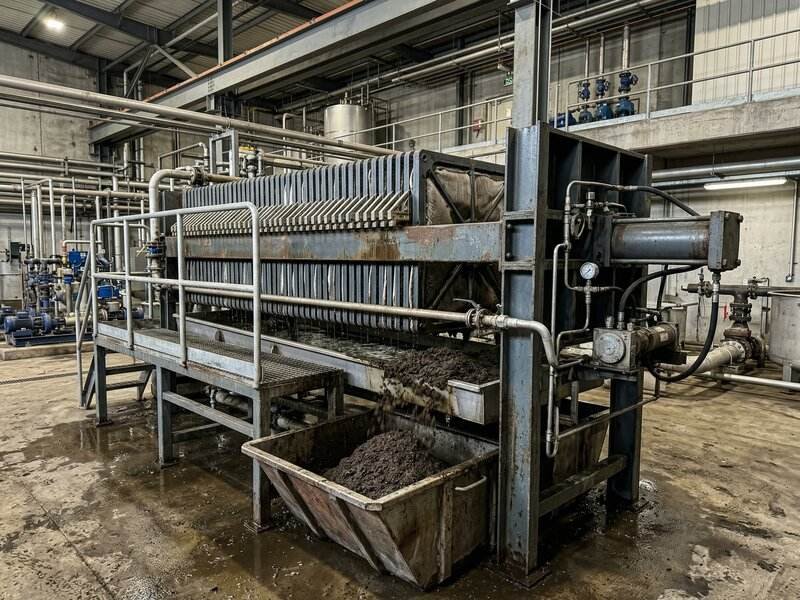
Filter Press for Sludge Dewatering
Automatic recessed-plate filter presses for sludge dewatering with matched feed pumps: 10–200 plates, 20–40% DS cake, for municipal and industrial sludge.
Technical Specifications
| Filter Volume | 0.5 – 200 m³ (number of plates dependent) |
| Plate Size | 470 × 470 mm to 2,000 × 2,000 mm |
| Number of Plates | 10 – 200 plates per press |
| Cake Dry Solids | 20 – 40% DS |
| Chamber Depth | 25 – 50 mm |
| Plate Material | Polypropylene (PP) copolymer |
| Frame Material | Carbon steel (painted) or SS304 |
| Closing Force | 50 – 3,000 kN (hydraulic) |
| Cloth Type | Polypropylene or polyester woven fabric |
| Standards | CE · PED 2014/68/EU |
Key Features
- Recessed plate design produces dry cakes up to 40% DS — maximising volume reduction
- Automatic plate shifting for fast discharge without manual intervention
- Polypropylene plates resist acid, alkaline, and chemical sludges
- Optional cloth washing system extends cloth life and reduces replacement frequency
- Membrane squeeze option increases cake dryness by an additional 3–8% DS
- Integrated sludge feed pump (centrifugal or mono) supplied as standard
Applications
- Municipal WWTP sludge dewatering
- Industrial wastewater sludge treatment
- Mining and mineral processing
- Chemical and pharmaceutical sludge
- Food processing sludge dewatering
- Water treatment plant sludge management
Product Overview
CM Aquatechnik supplies recessed-plate automatic filter presses for mechanical sludge dewatering from municipal and industrial wastewater treatment plants, water treatment plants, mining and chemical processes. A filter press produces sludge cake with 20–40% dry solids (DS), reducing the sludge volume by 5–10× compared to gravity thickening alone and dramatically lowering disposal or incineration costs.
Each press is sized to your sludge volume, solids content and target cake dryness, from 10 to 200 plates and 0.5 to 200 m³ filter volume. It comes complete with a sludge feed pump, hydraulic closing (50–3,000 kN), automatic plate shifting and polypropylene plates, with optional cloth washing and membrane squeeze. For a complete dewatering line we also supply polymer dosing systems for sludge conditioning and conveyors for cake discharge.
How a filter press works
- Conditioning — polymer or other conditioning chemicals are dosed into the sludge so that the solids flocculate and release water more easily.
- Filling — the feed pump pumps the sludge into the chambers between the plates. The filter cloths retain the solids while the filtrate drains away.
- Pressing — the feed pressure rises as the chambers fill with cake. With the optional membrane squeeze, inflatable membrane plates press the cake further and add 3–8% DS.
- Cake discharge — the press opens and the automatic plate shifter separates the plates one by one, so the cake drops onto a conveyor or into a container without manual work.
- Cloth washing — an optional washing system cleans the cloths between cycles, extending cloth life and keeping the filtration performance stable.
Filter press feed pumps
The feed pump decides how fast the press fills and how dry the final cake becomes. Every CM Aquatechnik filter press is supplied with an integrated sludge feed pump (Filterpressen-Beschickungspumpe) as standard, either centrifugal or mono (progressive cavity) type, selected for the sludge characteristics and the required filling pressure. Replacement and upgrade feed pumps for existing presses are available from our pump range.
Feeding usually runs in two phases: a fast filling phase at high flow and low pressure, followed by a pressing phase in which the flow drops while the pressure rises to the final filtration pressure, typically 6–15 bar depending on the press and the sludge. The pump must handle both phases without clogging or damaging the sludge flocs.
| Pump type | Typical use on a filter press |
|---|---|
| Progressive cavity (mono) pump | Most common for municipal and industrial sludge: steady, low-shear flow and a high final pressure, controlled by a variable speed drive. |
| Centrifugal pump | Fast initial filling of larger presses and easy-to-filter slurries; often combined with a second pump for the high-pressure phase. |
| Air-operated double diaphragm (AODD) pump | Small and pilot presses; simple, self-priming and pressure-limited by the compressed air supply. |
| Piston-membrane pump | Abrasive mineral slurries and very high filtration pressures, for example in mining and quarrying. |
Recessed-plate or membrane filter press?
| Recessed-plate press | With membrane squeeze | |
|---|---|---|
| Cake dryness | 20–40% DS | Additional 3–8% DS |
| Plates | Polypropylene recessed plates | Recessed and membrane plates |
| Best for | Standard municipal and industrial sludge | High disposal costs or strict cake dryness targets |
What we need to size your filter press
- Sludge type and origin, e.g. biological sludge, sludge from DAF units or lamella settlers, or mineral sludge
- Daily sludge volume (m³/day) and dry solids content of the feed sludge
- Required cake dryness and the cake disposal route
- Operating hours or shifts per day
Frequently asked questions
What cake dryness does a filter press achieve?
Typically 20–40% dry solids, depending on the sludge. The membrane squeeze option raises cake dryness by a further 3–8% DS.
Filter press or decanter centrifuge?
Filter presses generally reach a drier cake with lower energy consumption, while decanter centrifuges run continuously on a smaller footprint. Where cake dryness and disposal costs matter most, a filter press is usually the better choice.
Which sludges can be dewatered?
Municipal sewage sludge, industrial wastewater sludge, water treatment plant sludge, mining and mineral sludge, chemical and pharmaceutical sludge, and food processing sludge.
Which pump is used to feed a filter press?
Most filter presses for wastewater sludge are fed by a progressive cavity pump, because it delivers a steady, low-shear flow and reaches the final filtration pressure. Centrifugal pumps are used for fast filling of large presses, diaphragm pumps for small presses and piston-membrane pumps for abrasive slurries at very high pressure.
What feed pressure does a filter press need?
Recessed-plate filter presses are typically operated at a final feed pressure of 6–15 bar. The right value depends on the plate design, the sludge and the required cake dryness, and the feed pump is sized for both the filling flow and this final pressure.
Which materials are used?
Plates are made of polypropylene (PP) copolymer, which resists acid, alkaline and chemical sludges. Frames are painted carbon steel or SS304, and filter cloths are woven polypropylene or polyester.
Send us your sludge data and our engineers will prepare a technical and commercial proposal within 48 hours.