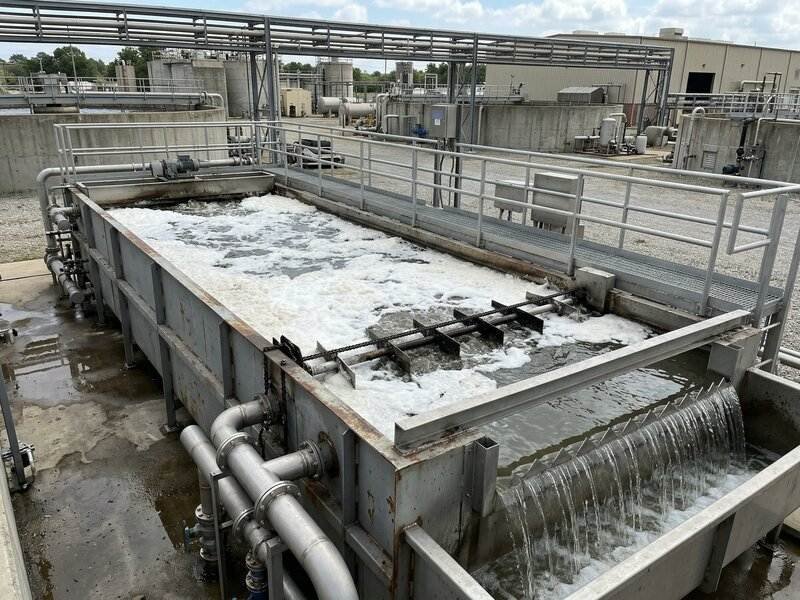
DAF Units
CM Aquatechnik supplies dissolved air flotation (DAF) units for removal of fats, oils, greases (FOG), suspended solids, and colloidal matter from food processing, refinery, dairy, and industrial efflu
Technical Specifications
| Flow Capacity | 2 – 500 m³/h |
| TSS Removal | 85 – 99% |
| FOG Removal | 90 – 99% |
| BOD Reduction (pre-treat) | 40 – 70% |
| Recycle Ratio | 10 – 30% of influent |
| Saturation Pressure | 4 – 6 bar |
| Surface Loading Rate | 3 – 10 m³/m²/h |
| Chemical Dosing | Coagulant + flocculant (optional integrated) |
| Float Sludge DS | 3 – 8% (food industry) |
| Standards | CE · EN 858 · ATEX (optional) |
Key Features
- High FOG removal (> 95%) required for food, dairy, and slaughterhouse effluent
- Compact rectangular design with low energy recycle pump
- Integrated coagulation and flocculation chamber for optimal TSS removal
- Automatic skimmer arm removes float sludge continuously
- Stainless steel 304/316L construction for food-grade applications
- Can be combined with biological treatment for full effluent compliance
Applications
- Food and beverage effluent pre-treatment
- Dairy processing wastewater
- Refinery and petrochemical produced water
- Abattoir and meat processing
- Paper and pulp mill effluent
- Municipal primary clarification
Product Overview
CM Aquatechnik supplies dissolved air flotation (DAF) units for removal of fats, oils, greases (FOG), suspended solids, and colloidal matter from food processing, refinery, dairy, and industrial effluents. DAF units generate microscopic air bubbles (20–100 µm) by dissolving air in a recycle stream under pressure, then releasing it in the flotation tank to float suspended matter to the surface as a concentrated float sludge.
Frequently asked questions
How does a DAF unit work?
A recycle stream of 10–30% of the influent is saturated with air at 4–6 bar and released into the flotation tank, where it forms microscopic bubbles of 20–100 µm. The bubbles attach to suspended solids and fats, oils and greases (FOG), float them to the surface, and an automatic skimmer removes the concentrated float sludge.
How is a DAF unit sized?
The main design parameters are the flow rate, the surface loading rate (typically 3–10 m³/m²/h) and the type and concentration of solids and FOG in the wastewater. Our units cover flows from 2 to 500 m³/h, and coagulant and flocculant dosing can be integrated where chemical conditioning is needed for optimal TSS removal.
Which materials are DAF units made of?
DAF units are available in stainless steel 304/316L construction for food-grade applications. ATEX-compliant versions are available as an option for applications such as refinery and petrochemical water.
What information do you need for a quotation?
Please tell us the flow rate (average and peak), the wastewater origin, and the TSS, FOG and BOD/COD concentrations, together with the required effluent quality. Information on available space, the preferred material and whether the DAF unit is followed by biological treatment is also helpful. Send us your requirements and we will prepare a proposal within 48 hours.