Lamella Settlers
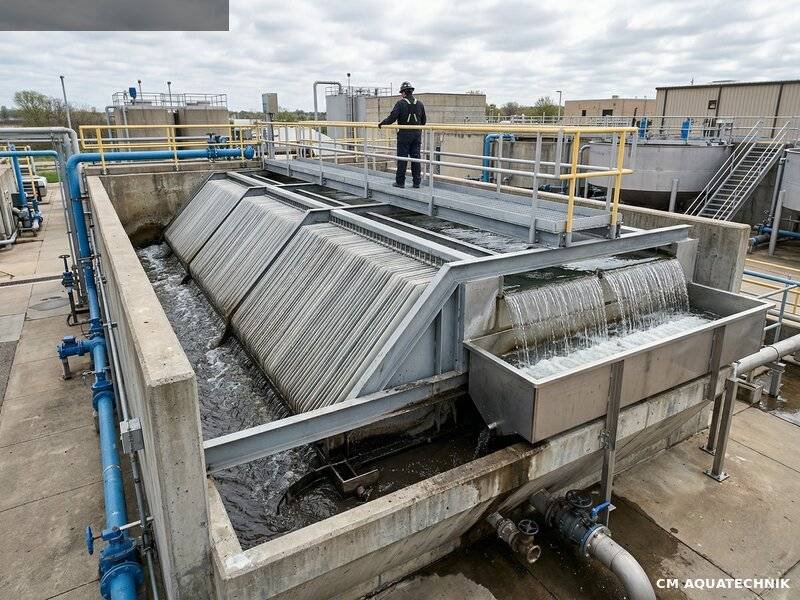
Lamella settlers with inclined tube or plate modules that raise effective settling area 5–10×, so existing clarifiers handle 3–5× higher loads.
Technical Specifications
| Types | Inclined tube settlers · inclined plate settlers |
|---|---|
| Plate/Tube Inclination | 55 – 60° (standard) |
| Specific Settling Area | 50 – 200 m²/m³ (module volume) |
| Surface Loading Rate | 2 – 8 m/h (application dependent) |
| TSS Removal | 70 – 95% (with coagulation) |
| Module Material | PVC · polypropylene · HDPE · FRP |
| Module Dimensions | Modular, custom-fit to existing tanks |
| Chemical Dosing | Coagulant/flocculant pre-treatment recommended |
| Installation | Retrofit or new-build |
| Standards | CE |
Key Features
- Increases existing clarifier capacity by 3–5× without additional tankage
- PVC and PP construction resists corrosion in aggressive wastewater
- Modular design for easy installation through access hatches
- Self-cleaning inclined surfaces prevent sludge accumulation
- Significantly reduces suspended solids load to downstream treatment
- Can be combined with flocculation aids for enhanced TSS removal
Applications
- Municipal primary and secondary clarification
- Industrial effluent TSS removal
- Retrofit of overloaded settling tanks
- Mining process water clarification
- Stormwater treatment
- Pre-treatment for biological systems
Product Overview
CM Aquatechnik supplies inclined tube and plate settler (lamella settler) modules for high-rate sedimentation in clarifiers and settling tanks. Lamella plates increase the effective settling area by 5–10× compared to conventional open clarifiers, dramatically reducing tank footprint and enabling existing tanks to handle 3–5× greater hydraulic loads.
How a lamella clarifier works
Inclined plates multiply the settling area in a small tank. The water rises between the plates while the solids settle only a few centimetres until they reach a plate, slide down and collect in the sludge hopper.
- Flocculation — coagulant and polymer are mixed in and the flocs grow in a flocculation tank, typically for 10–20 minutes.
- Inlet — the water is distributed evenly below or beside the plate pack.
- Settling — the water flows upwards between the plates, against the sliding sludge.
- Outlet — the clarified water leaves over weirs or through collecting pipes above the plates.
- Sludge — it thickens in the hopper and is drawn off by a pump or valve on a timer.
Selection and sizing
- Surface loading — 0.5–1.0 m/h on the projected plate area for flocculated solids, up to 1.5 m/h for heavy mineral solids.
- Plates — an angle of 55–60° and a spacing of 50–80 mm; wider spacing for sludge that tends to stick.
- Settling test — the settling velocity of the real flocs defines the surface loading.
- Sludge volume — the hopper and the withdrawal are sized for the solids load, with a scraper or thickener for larger units.
The lamella clarifier calculator estimates the plate area, the number of plates and the footprint.
What determines the cost
- Flow and surface loading — they set the plate area and the tank size.
- Material — coated carbon steel or stainless steel for the tank; plates in stainless steel or plastic.
- Flocculation stage — flash mixer, flocculation tank and dosing stations.
- Sludge equipment — hopper, scraper or thickener and sludge pump.
- Covers and access — covers against algae and odour, walkways and plates that can be removed for cleaning.
Frequently asked questions
How much can lamella settlers increase clarifier capacity?
Lamella plates increase the effective settling area by 5–10× compared with a conventional open clarifier. As a result, existing tanks fitted with lamella modules can typically handle 3–5× greater hydraulic loads without additional tankage.
Should I choose tube settlers or plate settlers?
Both types are available, normally installed at an inclination of 55–60°, with specific settling areas of 50–200 m²/m³ of module volume. The choice depends on the solids characteristics, the surface loading rate and the geometry of the tank, and we recommend the most suitable design for each application.
Which materials are the modules made of, and how are they installed?
Modules are supplied in PVC, polypropylene, HDPE or FRP, which resist corrosion in aggressive wastewater. The modular design is custom-fitted to existing tanks and can be installed through access hatches, either as a retrofit or in a new build.
What information do you need for a quotation?
Please provide the design and peak flow, the inlet TSS concentration and target outlet quality, the type of water or wastewater, and the dimensions of the existing or planned tank. Information on any coagulant or flocculant dosing already in place is also helpful. Send us your requirements and we will prepare a proposal within 48 hours.
Last updated: · Technical data are typical values; the final design follows your water analysis and project data. Stock availability in Neuss and lead times are confirmed with the quotation.