Cartridge Filter Housings
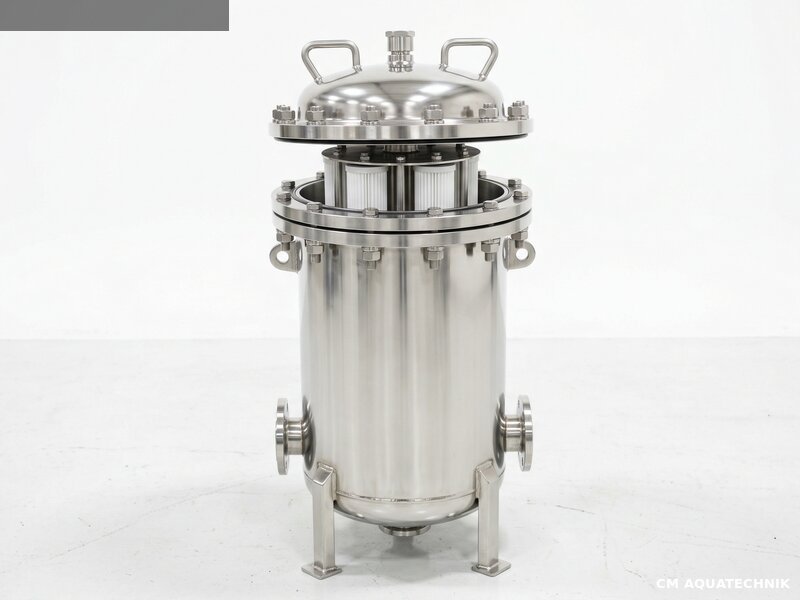
Cartridge filter housings in 304/316L stainless steel, carbon steel or PVC, holding 1 to 72 cartridges in 10" to 40" or 60" high-flow sizes.
Technical Specifications
| Housing Material | SS 304 / SS 316L / Carbon steel / PVC |
|---|---|
| Cartridges per Housing | 1 – 72 elements (size dependent) |
| Cartridge Sizes | 10", 20", 30", 40" (standard) · 60" (high-flow) |
| Port Size | ½" – 12" NPT or ANSI flanged |
| Operating Pressure | Up to 10 bar (SS) · 6 bar (PVC) |
| Operating Temperature | −5 °C – 120 °C (SS); 5 – 50 °C (PVC) |
| Closure Type | Swing bolt · quick-clamp · ASME bolted |
| Seal Material | Silicone · EPDM · PTFE · Viton |
| Standards | ASME · PED · FDA · 3-A · CE |
Key Features
- Electropolished interiors meet 3-A sanitary standards for food/pharma
- Swing-bolt quick-open closure for fast element change
- Vent and drain ports standard on all housings
- High-flow configurations reduce housing count by up to 90%
- Custom lengths and diameters available for special applications
- Surface finish options: 2B mill, mechanically polished, electropolished
Applications
- Industrial water and process liquid filtration
- Pharmaceutical sterile filtration
- Food and beverage
- Chemical production
- Power generation condensate polishing
- Oil and gas produced water
Product Overview
CM Aquatechnik supplies a complete range of standard and custom cartridge filter housings in 304/316L stainless steel, carbon steel, and PVC. Single to 72-cartridge configurations are available, in both standard 10″/20″ and high-flow 60″ formats. Standard flange or NPT threaded connections from ½” to 12″.
For flows above about 50 m³/h, high flow filter cartridges in 20″, 40″ or 60″ lengths need far fewer elements and smaller housings.
How a cartridge filter housing is built
- Shell and cover — a pressure vessel with a removable cover. The inlet is on the dirty side around the cartridges, the outlet below the tube sheet.
- Tube sheet — holds the cartridges and separates the unfiltered from the filtered side. Double-open-end cartridges sit on seats and are held down by a spring plate; cartridges with O-ring adapters plug into sockets.
- Vent and drain — the vent removes air when the housing is filled, the drains empty the dirty and the clean side before the cover is opened.
- Pressure gauges — the difference between inlet and outlet pressure shows the loading of the cartridges.
Selection and sizing
- Number of cartridges — the design flow divided by the permissible flow per cartridge; standard round numbers are 3, 5, 7, 12, 21, 36, 52 and 72.
- Cartridge length — 30″ and 40″ cartridges need fewer positions than 10″ and 20″ cartridges for the same flow.
- Seat type — double open end for general duty, 222 or 226 O-ring seats where no bypass is permitted, for example ahead of reverse osmosis in pharmaceutical water systems.
- Material — 304 stainless steel for drinking and process water, 316L for chloride-containing and hygienic applications, duplex or lined carbon steel for seawater, plastics for aggressive chemicals.
- Pressure and temperature — the design pressure follows the pump shut-off head, not only the working pressure.
The high flow cartridge calculator shows how many large-diameter cartridges replace a standard housing at high flows.
What determines the cost
- Size and material — the number of cartridge positions and the steel grade.
- Closure — clamp and swing-bolt closures open without tools; bolted covers are used for high pressures.
- Surface finish — polished and electropolished surfaces for hygienic duty.
- Code and documentation — pressure vessel approval, material certificates and test reports.
Frequently asked questions
Which housing material should I choose?
Stainless steel 304/316L housings are rated up to 10 bar and 120 °C and, with electropolished interiors, meet 3-A sanitary standards for food and pharmaceutical service. PVC housings are a cost-effective, corrosion-resistant choice for lower-pressure duties up to 6 bar and 5–50 °C, while carbon steel suits general industrial filtration. The final choice depends on the liquid, its temperature and pressure, and any hygiene requirements.
How do I size a cartridge filter housing?
The number and length of cartridges are determined by the flow rate, the required filtration rating, the solids load and the viscosity of the liquid, and we offer housings from a single element up to 72 cartridges. For flows above about 50 m³/h, high-flow cartridges in 20″, 40″ or 60″ lengths need far fewer elements and can reduce the number of housings by up to 90%.
How are the cartridges changed?
After the housing has been isolated, depressurised and drained via the standard vent and drain ports, the swing-bolt quick-open closure gives fast access to the elements. Cartridges are normally replaced when the differential pressure reaches the limit recommended for the element, which keeps downtime to a minimum.
What information do you need for a quotation?
Please tell us the flow rate, the liquid to be filtered and its temperature, the operating pressure, the required filtration rating and cartridge length, the connection size and type, your preferred housing and seal materials and surface finish, and any standards that apply (for example ASME, PED or 3-A). Send us your requirements and we will prepare a proposal within 48 hours.
Last updated: · Technical data are typical values; the final design follows your water analysis and project data. Stock availability in Neuss and lead times are confirmed with the quotation.