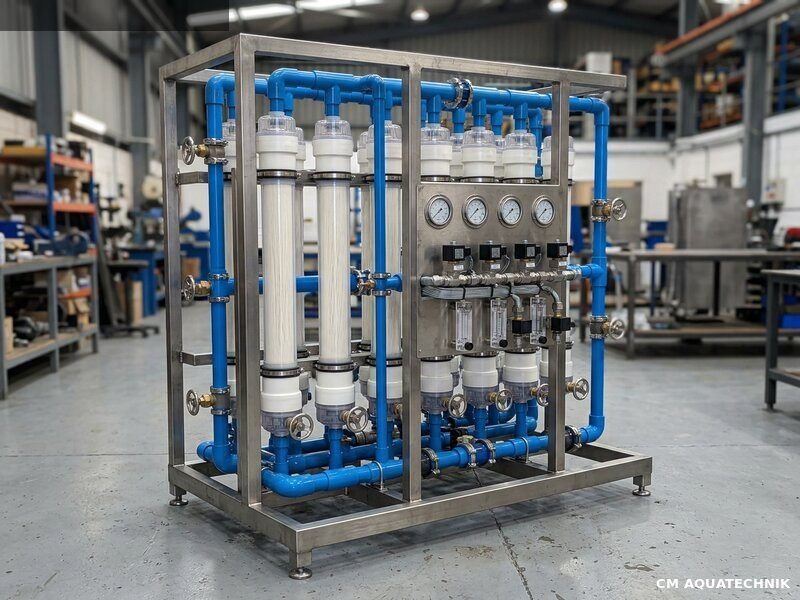
Ultrafiltration Systems
CM Aquatechnik designs and supplies PVDF hollow-fibre ultrafiltration (UF) systems for pre-treatment of surface water, river water, and secondary effluent ahead of reverse osmosis. UF membranes remove
Technical Specifications
| Membrane Type | PVDF hollow-fibre, inside-out or outside-in |
| Pore Size | 0.01 – 0.04 µm (ultrafiltration range) |
| Flux Rate | 40 – 120 LMH (net design flux) |
| SDI Output | < 3.0 (suitable for RO feed) |
| Turbidity Removal | > 99.9% (output < 0.1 NTU) |
| Bacteria Removal | ≥ 4-log (99.99%) |
| Backwash Frequency | Every 15 – 60 min (automatic) |
| CEB Frequency | Daily to weekly (automatic) |
| Operating Pressure | 0.1 – 2.5 bar (TMP) |
| Module Diameter | 6" – 10" housings |
| Standards | NSF 61 · WHO · CE |
Key Features
- Consistent SDI < 3 for reliable RO feed quality
- Absolute 0.04 µm barrier removes bacteria and Cryptosporidium
- Automated backwash reduces chemical consumption
- Low energy operation (< 0.1 kWh/m³)
- Compact footprint compared to conventional media filtration
- Air integrity testing capability for membrane breach detection
Applications
- RO pre-treatment (surface water)
- Municipal drinking water
- Industrial process water
- Seawater desalination pre-treatment
- Wastewater tertiary polishing
- Swimming pool water treatment
Product Overview
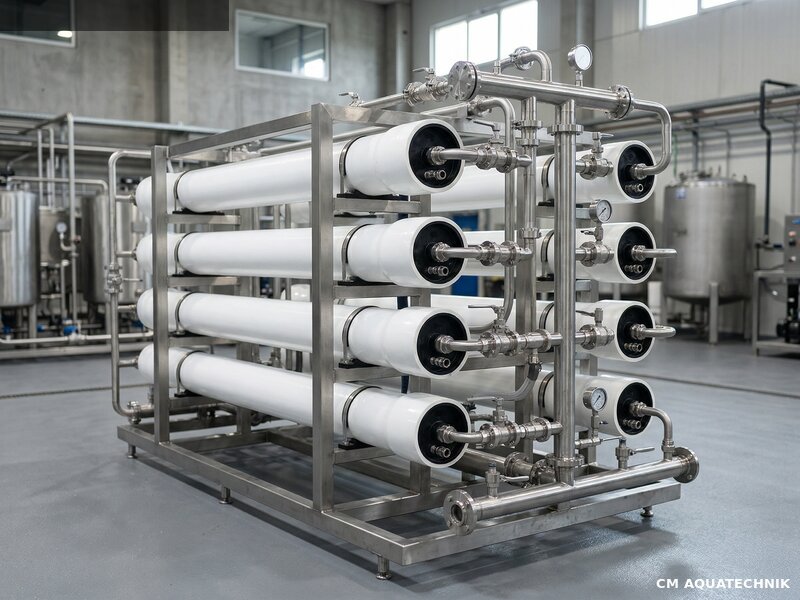
CM Aquatechnik designs and supplies PVDF hollow-fibre ultrafiltration (UF) systems for pre-treatment of surface water, river water, and secondary effluent ahead of reverse osmosis. UF membranes remove suspended solids, colloidal matter, bacteria, and viruses to consistently achieve SDI < 3, protecting downstream RO membranes and extending their operational life.
Each system features fully automated backwash and chemical-enhanced backwash (CEB) cycles, ensuring stable long-term performance without operator intervention. Systems are designed for dead-end or cross-flow filtration depending on feed water quality.
Frequently asked questions
Why use ultrafiltration as pre-treatment for reverse osmosis?
Ultrafiltration consistently delivers SDI < 3 and turbidity below 0.1 NTU by removing suspended solids, colloidal matter, bacteria and viruses. This gives the RO system a far more stable feed water quality than conventional media filtration, reducing membrane fouling and extending membrane life. UF systems also require a considerably smaller footprint.
How is an ultrafiltration system cleaned and maintained?
The membranes are cleaned by fully automatic backwash cycles every 15 to 60 minutes and by chemical-enhanced backwash (CEB) cycles carried out daily to weekly, without operator intervention. Air integrity testing allows membrane breaches to be detected reliably. Day-to-day operation mainly involves monitoring the transmembrane pressure and keeping the cleaning chemicals topped up.
Should I choose dead-end or cross-flow ultrafiltration?
The mode of operation depends on the feed water quality. Dead-end filtration is energy-efficient and well suited to feed water with relatively low solids content, while cross-flow filtration keeps the membrane surface cleaner when solids loading or fouling potential is high. We select the filtration mode and the fibre configuration (inside-out or outside-in) based on your water analysis.
What information do you need for a quotation?
Please provide the water source and a feed water analysis (turbidity, suspended solids, organic content and temperature range), the required net filtrate flow, the downstream process such as RO or drinking water supply, the required filtrate quality and the space available for installation. Send us your requirements and we will prepare a proposal within 48 hours.