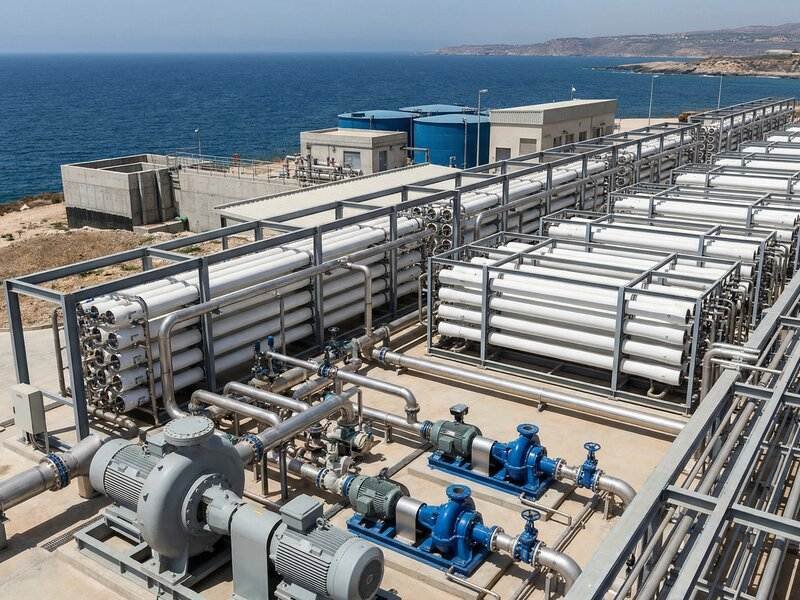
Seawater Reverse Osmosis (SWRO) Systems
Seawater reverse osmosis systems from 50 to 10,000 m³/day for coastal, island and offshore sites, with pre-treatment, energy recovery and PLC/SCADA control.
Technical Specifications
| Plant Capacity | 50 – 10,000 m³/day |
| Feed Water Salinity | Up to 45,000 mg/L TDS |
| Permeate TDS | < 300 mg/L (WHO drinking water standard) |
| System Recovery | 35 – 50% |
| Operating Pressure | 55 – 70 bar |
| Energy Recovery | Pressure exchanger (ERI PX series) |
| Specific Energy | 2.5 – 4.0 kWh/m³ product water |
| Membranes | DOW FILMTEC SW30HR / TORAY TM820 |
| Control System | Full PLC/SCADA with remote access |
| Standards | WHO · EU Drinking Water Dir · CE |
Key Features
- Pressure exchanger energy recovery reduces energy consumption by 60%
- Achieves WHO drinking water TDS < 300 mg/L from seawater
- Modular design enables capacity expansion without major changes
- Containerised option for rapid deployment on islands and remote sites
- Full pre-treatment train included for optimal RO membrane protection
- Remote SCADA monitoring for unmanned operation
Applications
- Island and coastal drinking water supply
- Tourist resorts and hotels
- Remote industrial camps
- Municipal seawater desalination
- Naval and offshore vessels
- Emergency water supply systems
Product Overview
CM Aquatechnik designs and supplies complete seawater reverse osmosis (SWRO) desalination systems from 50 m³/day to 10,000 m³/day. A reverse osmosis system for sea water turns seawater with up to 45,000 mg/L TDS into drinking or process water with less than 300 mg/L TDS, for coastal towns, islands, hotels and resorts, industrial plants, remote camps and offshore installations.
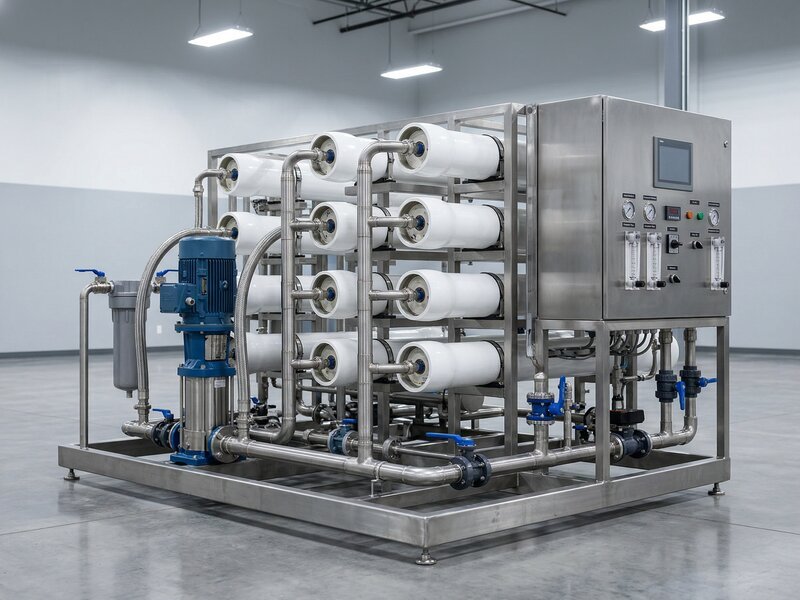
Each plant is engineered around your seawater analysis and water demand, and includes intake screening, pre-treatment (coagulation/flocculation, multimedia filtration, ultrafiltration or cartridge filtration), high-pressure SWRO membranes, an energy recovery device (pressure exchanger), post-treatment remineralisation and disinfection, and a full PLC/SCADA control system. With pressure exchanger technology our SWRO systems typically achieve a specific energy consumption of 2.5–4.0 kWh per m³ of product water.
How a seawater desalination plant works
- Intake and screening — seawater is drawn from an open intake or beach well and screened to remove debris and marine growth.
- Pre-treatment — coagulation/flocculation, multimedia filtration and UF or cartridge filters remove suspended solids and protect the membranes; dosing pumps add antiscalant and other conditioning chemicals.
- High-pressure pumping and energy recovery — high-pressure pumps raise the feed to 55–70 bar. A pressure exchanger transfers the pressure of the outgoing brine back to the incoming seawater, which reduces the energy demand by up to 60%.
- Reverse osmosis — spiral-wound SWRO membranes (DOW FILMTEC SW30HR or TORAY TM820) in membrane pressure vessels separate the salt. 35–50% of the feed becomes product water; the rest leaves as concentrated brine.
- Post-treatment — remineralisation, pH correction and disinfection make the permeate stable and safe for drinking water distribution.
- Control and monitoring — a PLC/SCADA system runs the plant automatically, with remote monitoring for unmanned operation.
Indicative plant sizes
| Product water | Per hour | Seawater feed* | Typical design |
|---|---|---|---|
| 50 m³/day | ≈ 2 m³/h | ≈ 5 m³/h | Skid or 20 ft container |
| 250 m³/day | ≈ 10 m³/h | ≈ 26 m³/h | Skid or 40 ft container |
| 1,000 m³/day | ≈ 42 m³/h | ≈ 104 m³/h | Skid-mounted RO train |
| 5,000 m³/day | ≈ 208 m³/h | ≈ 520 m³/h | Multiple parallel trains |
| 10,000 m³/day | ≈ 417 m³/h | ≈ 1,040 m³/h | Multiple parallel trains |
* At 40% recovery. The actual design depends on seawater salinity, temperature, intake type and the required product water quality.
Containerised and mobile SWRO plants
For islands, resorts, remote industrial camps, offshore sites and emergency water supply, SWRO plants from 5 to 500 m³/day can be delivered as containerised RO systems in 20 ft or 40 ft ISO containers, with pre-treatment, membranes, post-treatment and the control panel pre-installed. Several containers can be linked when more capacity is needed.
Offshore and marine reverse osmosis systems
For offshore platforms, FPSOs, accommodation and supply vessels, and other marine installations we supply compact seawater reverse osmosis units that produce drinking water and technical water directly from the sea. Offshore RO systems are designed around the limited space, weight and power available on board:
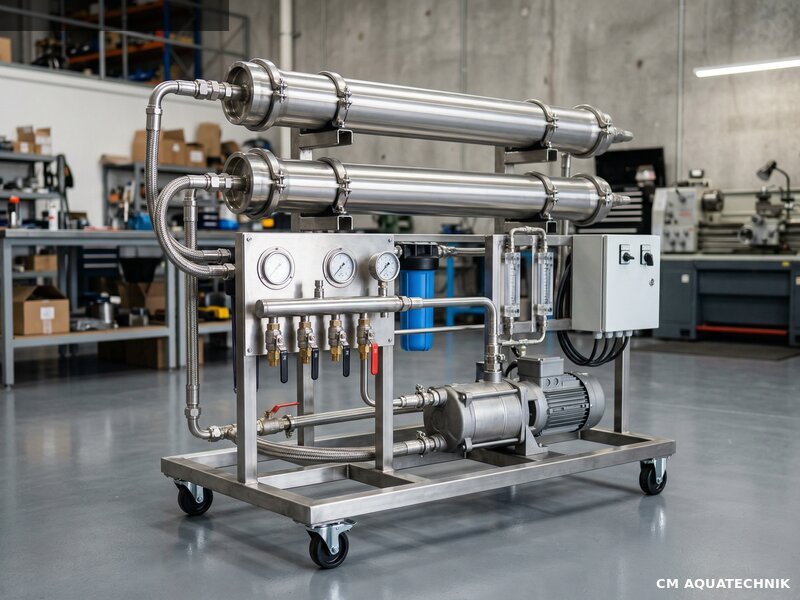
- Compact skid design — pre-treatment, high-pressure pump, membranes and control panel on one frame, sized to the deck space and access openings.
- Seawater-resistant materials — high-pressure piping in super duplex or 904L stainless steel, GRP and PVC-U on the low-pressure side.
- Unmanned operation — automatic start/stop, membrane flushing and alarms through the PLC, with signals to the platform or ship control system.
- Project requirements — the electrical design, documentation and inspections are matched to the project specification and the applicable offshore or classification standards.
Typical offshore and marine SWRO capacities range from 5 to 500 m³/day. For larger demand, several units run in parallel so that one can be serviced while the others keep producing water.
What determines the design
- Seawater quality — salinity (TDS), temperature range, turbidity/SDI and the intake type decide the pre-treatment and the membrane design.
- Product water use — drinking water to WHO guidelines and the EU Drinking Water Directive, or process and boiler feed water, which may need a second RO pass.
- Energy and site conditions — available power supply, installation space and whether the plant runs unmanned.
- Brine discharge — the concentrated brine is returned to the sea; its outfall and the local discharge permit are part of the design.
Frequently asked questions
How much energy does a seawater RO plant use?
With a pressure exchanger for energy recovery, our SWRO systems typically need 2.5–4.0 kWh per m³ of product water. The exact figure depends on salinity, temperature and recovery.
How much seawater is needed per m³ of drinking water?
At a recovery of 35–50%, about 2 to 2.9 m³ of seawater is needed for every m³ of product water. A 1,000 m³/day plant therefore takes in roughly 2,000–2,900 m³ of seawater per day.
What water quality does SWRO produce?
The permeate has less than 300 mg/L TDS. After remineralisation and disinfection it meets WHO drinking water guidelines and the EU Drinking Water Directive. A second RO pass can be added where lower TDS is required.
Can a reverse osmosis system be used offshore or on ships?
Yes. Compact SWRO units are widely used on offshore platforms, FPSOs and vessels to produce drinking and technical water from seawater. They are built with seawater-resistant materials, run automatically and are sized to the available deck space and power supply.
What is the difference between seawater RO and brackish water RO?
Seawater contains about 35,000–45,000 mg/L of dissolved salts, so SWRO plants operate at 55–70 bar with seawater membranes and an energy recovery device. Brackish and fresh water with lower salinity is treated with industrial reverse osmosis systems at much lower pressure and energy consumption.
What information do you need for a quotation?
A seawater analysis (TDS, temperature range, turbidity), the required product water flow and quality, the intake type, the site location and the available power supply. Send us your requirements and our engineers will prepare a technical and commercial proposal within 48 hours.