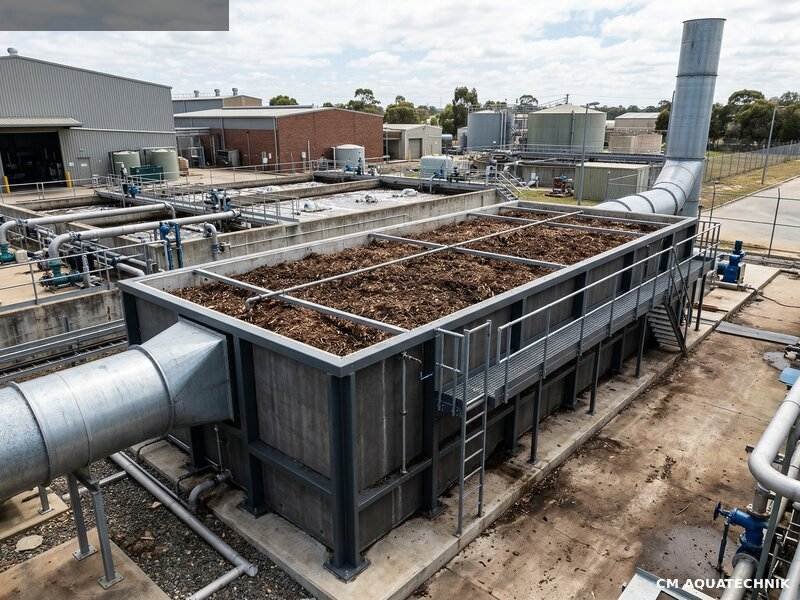
Odour Control & Air Treatment
CM Aquatechnik supplies turnkey odour control and air treatment systems for H₂S, ammonia (NH₃), mercaptans, and VOC odour control at wastewater treatment plants, pumping stations, sludge handling area
Technical Specifications
| Technologies | Biofilter · biotrickling filter · chemical scrubber · carbon adsorber |
| Compounds Treated | H₂S · NH₃ · mercaptans · VOCs · amines |
| Inlet H₂S Concentration | Up to 500 ppm (scrubber) · < 100 ppm (biofilter) |
| Removal Efficiency | ≥ 99% H₂S (scrubber) · ≥ 95% H₂S (biofilter) |
| Treated Air Volume | 500 – 100,000 m³/h |
| Pressure Drop | < 200 Pa (biofilter) · < 1,000 Pa (scrubber) |
| Fan | Centrifugal with ATEX-rated motor |
| Scrubber Media | Structured or random packing (PP/FRP) |
| Biofilter Media | Organic (compost/wood) · synthetic carrier |
| Standards | CE · ATEX · EN 13725 · TA Luft |
Key Features
- Biotrickling filter provides stable performance with low water consumption
- Two-stage scrubber (acid + alkaline) achieves > 99.9% H₂S removal
- Activated carbon polishing stage ensures compliance with odour emission limits
- ATEX-rated fans and electrical equipment throughout for safe H₂S service
- Automatic chemical dosing on scrubbers maintains optimal pH for H₂S removal
- Remote monitoring of H₂S inlet/outlet, fan status, and chemical levels
Applications
- WWTP headworks and primary treatment buildings
- Sludge thickening and dewatering areas
- Anaerobic digestion and biogas areas
- Municipal pumping stations
- Industrial effluent treatment facilities
- Composting and biosolids processing
Product Overview
CM Aquatechnik supplies turnkey odour control and air treatment systems for H₂S, ammonia (NH₃), mercaptans, and VOC odour control at wastewater treatment plants, pumping stations, sludge handling areas, and industrial facilities. Systems are designed following EN 13725 odour characterisation and local regulatory discharge limits.
Available technologies include biofiltration (biotrickling or open bed), single-stage or two-stage chemical wet scrubbing (acidic + alkaline/oxidising), and activated carbon adsorbers. Hybrid systems combine technologies for optimal cost and performance.
Frequently asked questions
Which odour control technology suits my application?
Biofilters and biotrickling filters are an economical choice for moderate H₂S loads below 100 ppm, whereas chemical scrubbers handle inlet concentrations of up to 500 ppm. Activated carbon adsorbers are often used as a polishing stage, and hybrid systems combine technologies for optimal cost and performance.
What removal efficiencies can be achieved?
Chemical scrubbers achieve at least 99% H₂S removal and biofilters at least 95%, while two-stage acid and alkaline scrubbing achieves more than 99.9%. The actual design is based on the measured inlet concentrations, the air volume and the applicable emission limits.
How is the air volume to be treated determined?
The air volume is derived from the enclosed volumes and the required air change rate, plus extraction from covered tanks and process equipment; our systems cover 500 to 100,000 m³/h. Tight enclosures and extraction points close to the source keep the air volume, and therefore system size and operating costs, to a minimum.
What information do you need for a quotation?
Please provide the odour sources and enclosed volumes to be ventilated, the required air flow if known, measured or expected concentrations of H₂S, NH₃ and other compounds, the applicable emission limits, the space and utilities available and any ATEX zoning. Send us your requirements and we will prepare a proposal within 48 hours.