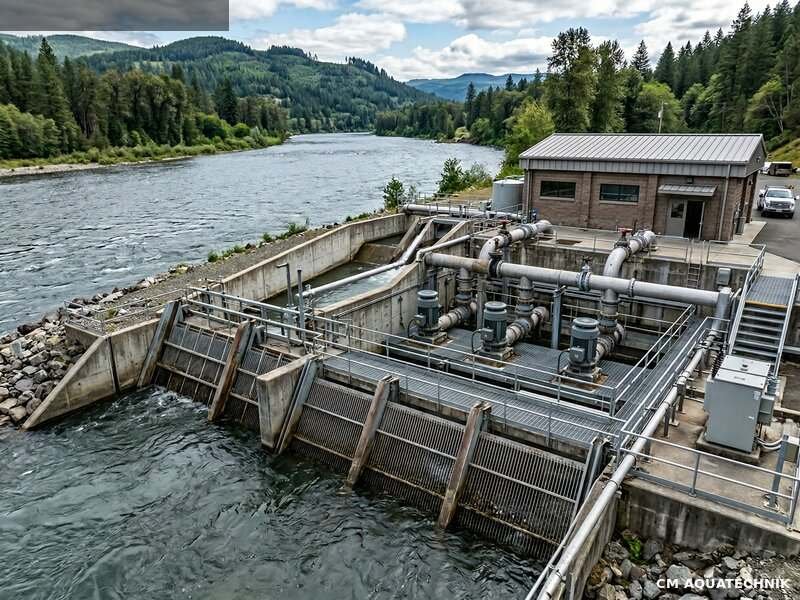
River Water Treatment Systems
CM Aquatechnik designs and supplies complete river water abstraction and treatment packages for municipal water supply and industrial use. Each system includes intake screening, pre-chlorination (opti
Technical Specifications
| Plant Capacity | 10 – 5,000 m³/h |
| Inlet Turbidity | Up to 2,000 NTU |
| Outlet Turbidity | < 0.5 NTU (direct filtration to < 100 NTU inlet) |
| Coagulants | Aluminium sulphate · PAC · ferric chloride |
| Flocculants | Polyacrylamide · polyDADMAC |
| Sedimentation Type | Lamella settler · DAF · dissolved air |
| Filtration | Dual-media or multimedia pressure filters |
| Disinfection | Chlorine · UV · ozone |
| Control | PLC/SCADA with turbidity and residual chlorine monitoring |
| Standards | WHO · EU Drinking Water Directive (EU) 2020/2184 · CE |
Key Features
- Complete process train from river intake to distribution-quality drinking water
- Jar testing service to optimise coagulant type and dose for your source water
- Lamella settlers significantly reduce civil work area vs. open clarifiers
- Automatic coagulant dosing adjusts to turbidity spikes in real time
- Includes all process controls: turbidity, pH, residual chlorine, flow metering
- Full O&M documentation and operator training provided
Applications
- Municipal river water abstraction plants
- Industrial intake water treatment
- Agricultural irrigation water treatment
- Emergency and humanitarian water supply
- Mining camp potable water
- Recreational water treatment
Product Overview
CM Aquatechnik designs and supplies complete river water abstraction and treatment packages for municipal water supply and industrial use. Each system includes intake screening, pre-chlorination (optional), coagulation/rapid mixing, flocculation, sedimentation (or DAF for algae-heavy water), multimedia filtration, activated carbon filtration, disinfection, and pH correction for distribution.
Frequently asked questions
What does a river water treatment plant consist of?
A complete plant includes intake screening, optional pre-chlorination, coagulation and rapid mixing, flocculation, sedimentation (or DAF for algae-heavy water), multimedia filtration, activated carbon filtration, disinfection and pH correction. Each package is designed as a complete process train from the river intake to distribution-quality water.
Can the plant cope with changing raw water turbidity, for example after heavy rain?
Yes. The plants are designed for inlet turbidity of up to 2,000 NTU and produce outlet turbidity below 0.5 NTU, and automatic coagulant dosing adjusts to turbidity spikes in real time. For raw water consistently below 100 NTU, direct filtration without a separate sedimentation stage can be an option.
How are the coagulant and dose selected?
We offer a jar testing service to optimise the coagulant type and dose for your source water. Typical coagulants are aluminium sulphate, polyaluminium chloride (PAC) and ferric chloride, combined with polyacrylamide or polyDADMAC flocculants.
What information do you need for a quotation?
Please tell us the required plant capacity, the intended use of the treated water (drinking water, industrial or irrigation) and the available raw water analysis, in particular the turbidity range and any seasonal variations. Your preferred disinfection method and information on the site and the river intake are also helpful. Send us your requirements and we will prepare a proposal within 48 hours.