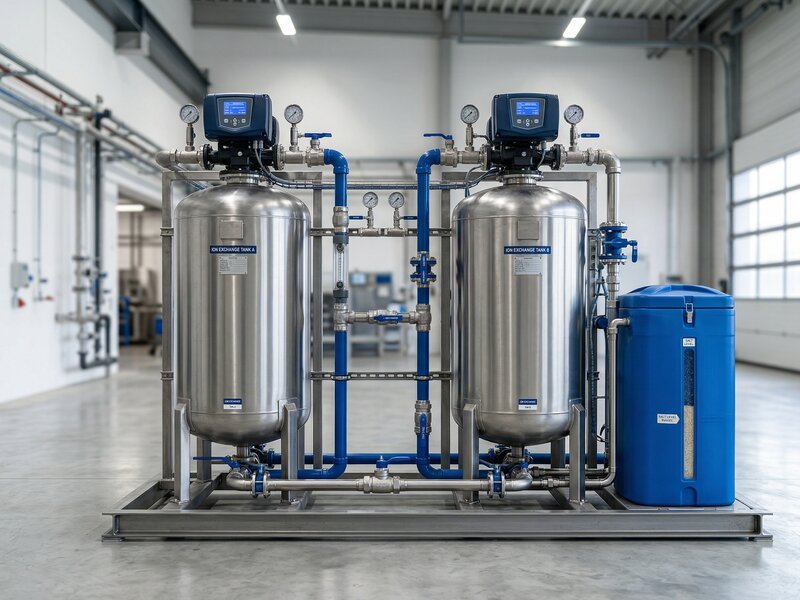
Automatic Softening Systems
CM Aquatechnik supplies fully automatic water softening stations designed for continuous industrial operation. Available in simplex and duplex (alternating) configurations, these systems use strong-ac
Technical Specifications
| Flow Capacity | 0.5 – 200 m³/h |
| Inlet Hardness | Up to 60 °dH (1,060 ppm CaCO₃) |
| Outlet Hardness | < 1 °dH (food-grade: < 0.1 °dH) |
| Operating Pressure | 2.5 – 8.0 bar |
| Regenerant | NaCl (common or food-grade salt) |
| Control Valve | Autotrol / Fleck / Clack multiport |
| Vessel Material | FRP (NSF61) or epoxy-lined carbon steel |
| Resin Type | Strong acid cation, gel or macroporous |
| Resin Volume | 25 L – 5,000 L per vessel |
| Salt Consumption | 80 – 150 g NaCl / °dH / m³ |
| Standards | DIN 19636 · EN 14743 · CE |
Key Features
- Fully automatic operation with no manual intervention
- Duplex configuration for uninterrupted 24/7 service
- Timer or meter-initiated regeneration for optimal salt efficiency
- NSF61 resin available for potable water applications
- Remote monitoring and alarm output available
- Compact skid design for easy installation
Applications
- Boiler feed water
- Cooling tower make-up
- CIP water in food & beverage
- Process water in laundries
- Hospital and hotel water systems
- Industrial washing and rinsing
Product Overview
CM Aquatechnik supplies fully automatic water softening stations designed for continuous industrial operation. Available in simplex and duplex (alternating) configurations, these systems use strong-acid cation exchange resin to replace calcium and magnesium ions with sodium, eliminating scale formation in boilers, heat exchangers, and process equipment.
Each system includes high-flow multiport control valves (Autotrol, Fleck, or Clack), NSF61-approved FRP resin vessels, polyethylene brine tanks with brine refill valves, and a metered or timer-controlled regeneration sequence. Duplex units offer uninterrupted soft water supply with no break in service during regeneration.
Operating Principle
Hard water passes through a bed of sulphonic cation exchange resin in sodium form. Calcium and magnesium ions are exchanged for sodium ions, producing softened water. When the resin is exhausted, an automatic valve initiates regeneration using sodium chloride brine, restoring full softening capacity.
Frequently asked questions
How do I size a water softening system for my application?
Sizing is based on the required flow rate, the raw water hardness and the volume of soft water needed between regenerations. Our systems cover flow capacities from 0.5 to 200 m³/h, inlet hardness up to 60 °dH and resin volumes from 25 L to 5,000 L per vessel. We calculate the resin volume and regeneration interval from your water analysis and consumption profile.
What is the difference between a simplex and a duplex softener?
A simplex system uses a single resin vessel, so soft water supply is interrupted while the resin regenerates. A duplex (alternating) system has two vessels: one is in service while the other regenerates, providing uninterrupted 24/7 soft water. Duplex units are the preferred choice for boiler feed water and other processes that cannot tolerate a break in supply.
How much salt does a softener use and what maintenance is required?
Salt consumption is typically 80 to 150 g NaCl per °dH per m³ of treated water, and meter-initiated regeneration helps to optimise salt efficiency. Regeneration runs fully automatically, so routine maintenance mainly consists of keeping the brine tank filled with salt and regularly checking the outlet hardness.
What information do you need for a quotation?
Please tell us your raw water hardness, the required flow rate and daily soft water consumption, operating pressure and operating hours, the target outlet hardness, whether you need a simplex or duplex configuration and whether the water is used for potable or food-grade applications. Send us your requirements and we will prepare a proposal within 48 hours.