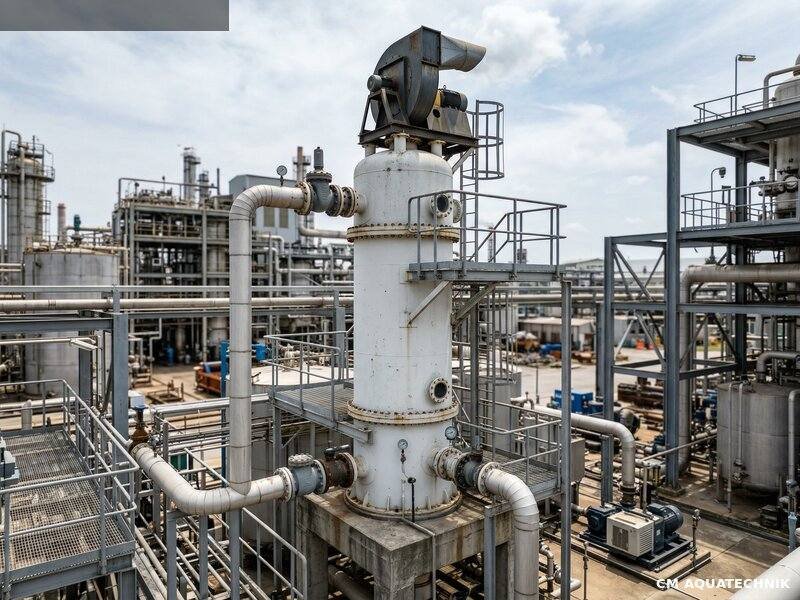
Degasser Systems
CM Aquatechnik supplies forced-draft decarbonation (degassing) towers for CO₂ and H₂S removal from RO permeate and post-lime softened water. CO₂ stripping is essential after RO trea
Technical Specifications
| CO₂ Removal Efficiency | > 95% |
| Inlet CO₂ | Up to 150 mg/L |
| Outlet CO₂ | < 5 mg/L |
| Flow Capacity | 1 – 500 m³/h |
| Tower Material | GRP/FRP or polypropylene |
| Packing Type | Random packing (Hiflow rings · Raschig) |
| Air:Water Ratio | 10:1 to 30:1 (volumetric) |
| Fan Type | Axial (forced draft) · Centrifugal (induced draft) |
| Tower Height | 2 – 6 m (capacity dependent) |
| Standards | CE · ATEX (fan, optional) |
Key Features
- Forced-draft design ensures consistent CO₂ removal regardless of ambient humidity
- GRP/FRP tower construction resists CO₂-acidified water corrosion
- Random packed bed provides high specific surface area for mass transfer
- Automatic fan control (VFD) reduces energy consumption at part load
- Compact footprint: 1 m² footprint per 10 m³/h typical
- Easily retrofitted to existing RO systems
Applications
- RO permeate CO₂ stripping
- Post-lime softening decarbonation
- H₂S removal from borehole water
- Decarbonation ahead of ion exchange and EDI for boiler feed water
- Aquaculture oxygen control
- Industrial process water deaeration
Product Overview
CM Aquatechnik supplies forced-draft decarbonation (degassing) towers for CO₂ and H₂S removal from RO permeate and post-lime softened water. CO₂ stripping is essential after RO treatment to prevent re-acidification of remineralised water, reduce acid consumption in downstream ion exchange, and prevent corrosion in distribution systems.
Frequently asked questions
Why is CO₂ removed after reverse osmosis?
RO permeate often contains dissolved CO₂, which lowers the pH and makes the water aggressive. Stripping the CO₂ prevents re-acidification of remineralised water, reduces acid consumption in downstream ion exchange and helps to prevent corrosion in distribution systems.
How does a forced-draft degasser work?
The water is distributed over a random packed bed in the tower while a fan blows air upwards through the packing, so the dissolved gas transfers from the water into the air stream. With a volumetric air-to-water ratio of 10:1 to 30:1, CO₂ concentrations of up to 150 mg/L can be reduced to below 5 mg/L.
How much space does a degasser need, and can it be added to an existing plant?
Typically about 1 m² of footprint is needed per 10 m³/h of flow, with tower heights of 2–6 m depending on capacity. Degassers are easily retrofitted to existing RO systems, and automatic fan control with a VFD reduces energy consumption at part load.
What information do you need for a quotation?
Please tell us the flow rate, the inlet CO₂ concentration (or pH and alkalinity), the required outlet value, any other gases to be removed such as H₂S, the water temperature, the space and height available, your preferred tower material and whether an ATEX-rated fan is required. Send us your requirements and we will prepare a proposal within 48 hours.